

 Shortly after the new fan film guidelines were announced by CBS and Paramount, a number of fans feared that these new rules would spell the end of fan films as we know them. I was among those fearing the worst, and I certainly felt a shiver of doom when, shortly thereafter, the venerable grandfather of the modern Star Trek fan film, New Voyages, announced the end of new episode production.
The biggest question fans debated was: can fan films exist within the constraints imposed by the new guidelines? Is 15 minutes long enough to tell a compelling story? Can a decent fan film be made with only $50,000 in public funding? Does a fan film need to pay professional actors and crew to be a quality production? And most of all, is it possible to have a continuing fan series if there cannot be established characters who appear in more than one 15-minute episode (or a single two-parter)?
Admitted, the answer to each of these questions is technically "yes." Nothing prevents a fan film from being made, 15 minutes long, modest budget, no paid professionals, and a one-shot story. But with all the fan productions out there already, how would they adapt to these new regulations? Would they go the way of Renegades and simply jettison all references to Star Trek out the airlock? Would they roll the dice like Star Trek Continues and race to release their final episodes, even though those final episodes would not be following the guidelines? Or would they try to conform as best they could?
In the three months immediately following the announcement of the guidelines, there was only a drip-drop of new Star Trek fan film releases. Mainly, there were a few short 5-to-8-minute episodes posted by Potemkin Pictures, which had pretty much been following most of the guidelines anyway over the years and had a good amount of footage already in the can waiting to be edited. There were also two really short-shorts, PenPals and PenPals 2 from Starship Valiant and Melbourne, respectively. Those seem to be more teaser than fan film--it's hard to tell just yet--but they appear to be following all of the guidelines, as well.
And of course, the big premiere was Star Trek Continues' latest masterpiece, the 44-minute long "Embracing the Winds," which they posted on September 3. And finally, less than a month ago, Trek Isolation released their 6-minute debut episode "Out of the Fire," which I discussed on this blog three weeks ago.
 And then, in short order, three other fan series released new episodes--completely separately from each other and in the span of less than two weeks! Starship Antyllus posted its 9th full-length episode, a 35-minute production titled "Ripple Effect." A week later, the long-running Aurora finally completed the last part of its second episode "Mudd in Your I," this one a total of 38 minutes long. And most recently, the new anthology series The Federation Files debuted its premiere episode, the 47-minute long "His Name Is Mudd." (Harry Mudd is sure showing up a LOT lately!)
So what does this mean for the guidelines? Are fan films "not dead yet!"? Are productions finding ways to successfully adapt to the guidelines and still live long and prosper?
To be honest, the jury is still out on those answers. Obviously, Star Trek Continues is the 800-pound mugato in the cave at the moment. Their stated intention to release another four episodes that do not conform with the guidelines (an ongoing series, run-times more than 15 minutes long, paying professionals, etc.) is definitely gutsy. But writer/director/producer James Kerwin said that there was an important distinction to realize about the guidelines. They state that if a fan production follows all of the guidelines, then the studios will not sue. But it doesn’t say that if a fan production doesn’t follow these guidelines, then the studios definitely will sue. So what STC is hoping is that, when they release their final four episodes over the next year or two, the studios will choose not to sue...which, of course, is a definite possibility. Maybe they will just get a phone call or e-mail. Maybe the studios will just keep silent. We'll see.
But how about the other recent fan film releases? Are they adapting like Borg in a cube? Well, yes, no, and maybe...
 Starship Tristan, like the other Potemkin Pictures fan series, is simply changing the name of their "series" with each new episode to the title of that particular episode.
As I said, the Potemkin Pictures releases had few changes to make to conform. They simply dropped the series names "Project: Potemkin", "Starship Tristan", "Starship Deimos", etc. and had each episode's title serve as the name of the fan film release itself. In this way, they weren't releasing ongoing "series" so much as separate fan films. Of course, once they start featuring the same characters in multiple episodes, they're flirting with not being in compliance with the first guideline: "The fan production must be less than 15 minutes for a single self-contained story, or no more than 2 segments, episodes or parts, not to exceed 30 minutes total, with no additional seasons, episodes, parts, sequels or remakes." But we'll see if the studios make a fuss if the fan series has almost no budget and is following every other guideline perfectly.
For Trek Isolation, it's probably a little too soon to tell if they'll be able to comply with all the guidelines. Their first episode certainly does, but if their next episode features the same series name and characters, then it may run afoul of guideline #1.
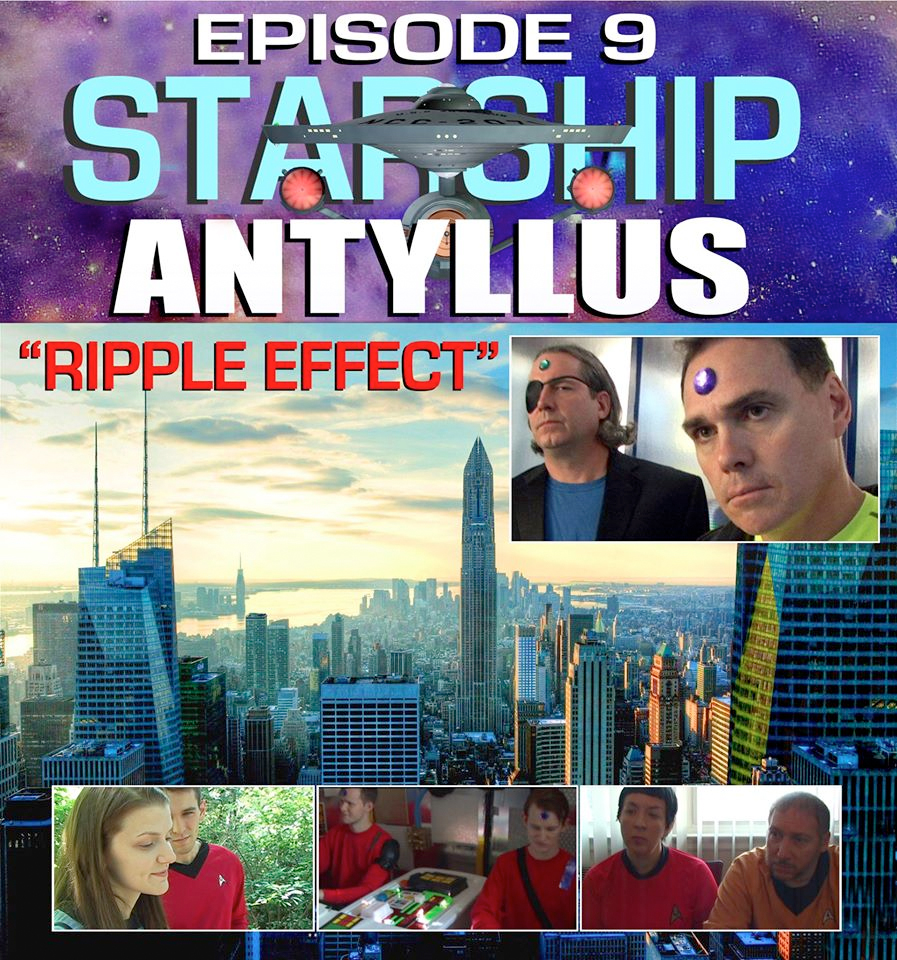 Starship Antyllus changed its series title from Star Trek: Antyllus after producing eight episodes under the previous name. Guideline #2 says "The title of the fan production or any parts cannot include the name 'Star Trek.'" However, here's another case where simply having an ongoing series violates guideline #1 again. And then, of course, there's the length of the episode (20 minutes over the 15-minute limit). Show-runner George Kayaian, who has been making Star Trek fan films continuously since 1994(!!!), told me the following:
I’m trying my best to follow the guidelines, and I’m hoping that the grandfather clause still applies since this episode and the next couple were created before the guidelines came into being. It’s just taking me a while to get things posted in this incredibly busy period of time in my life. My series is self-funded, or no budget at all for that matter! And each episode is made with my family and friends with love and no pay. We are a true fan film project. I hope the powers that be appreciate that and realize where I’m coming from. Even my YouTube channel is NOT monetized! Everything I do is for love and creativity.
Amen to that, George. So let's move on the the next recent release...
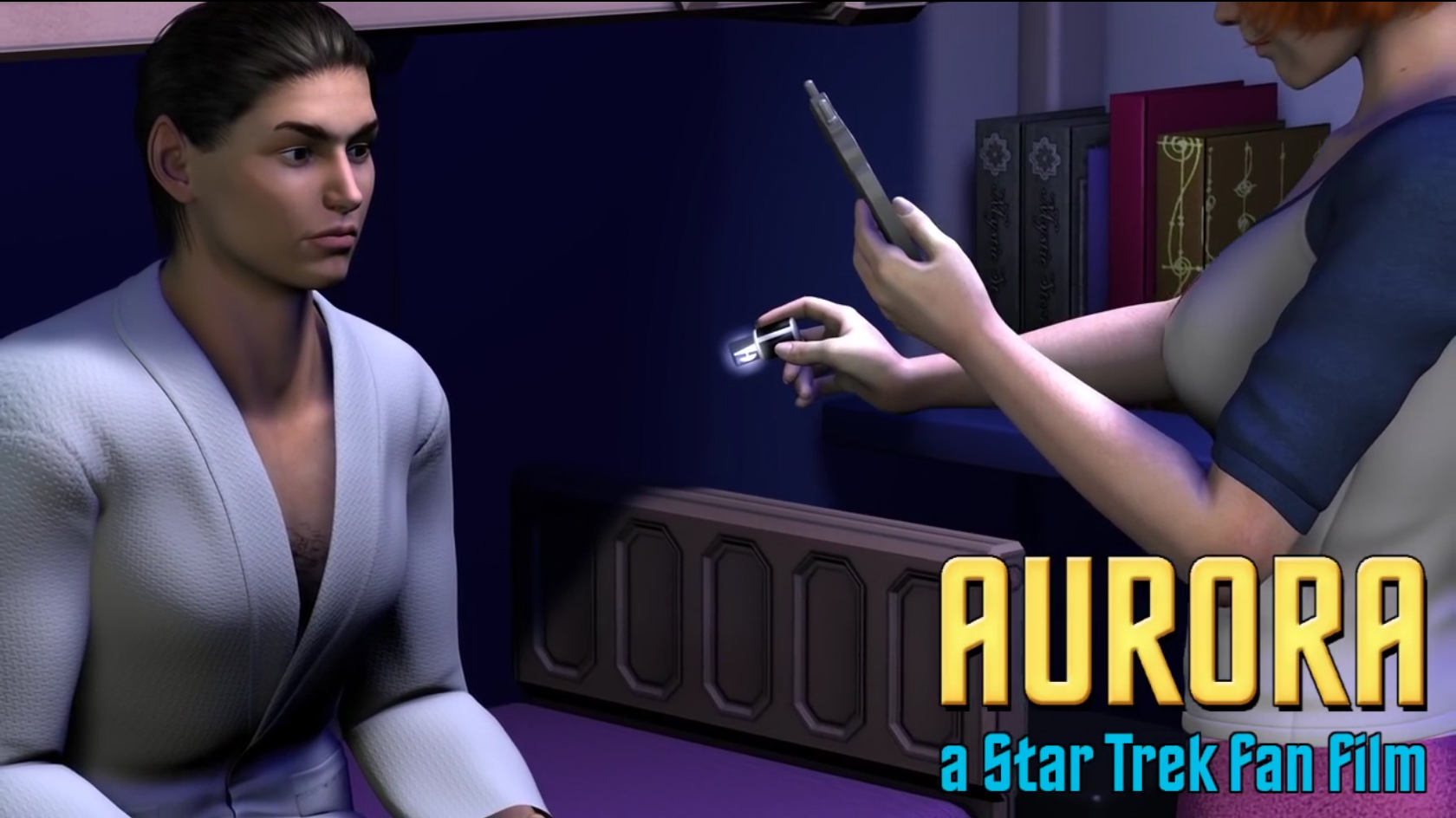 Like Antyllus, Star Trek: Aurora had to change its name to just Aurora to comply with guideline #2. Also, it was finishing up a 5-part episode, the first four parts of which had all been released over the three years prior to the new guidelines being announced. Many fan films/series are assuming a "grace period" or "grandfather clause" from the studios that will allow projects that were already late in production/post production when the guidelines were announced to finish them up and release. Unfortunately for Renegades, they didn't get in under the wire. But Aurora pretty much did.
But what of the future of Aurora? This series was known and celebrated for introducing two of the most interesting, compelling, and well-developed characters of any fan series: Captain Kara Carpenter and her Vulcan first-mate, T'Ling. As much as fans of Aurora (like myself) might want to see more of the adventures of these two fascinating women, well, why not let Aurora creator and show-runner Tim Vining tell you himself:
As many fans know, recent guidelines from CBS/Paramount, the owners of Star Trek's copyright, have placed new restrictions on fan films, in particular regarding the use of recurring original characters in fan films, so the future for Kara and T'Ling is a bit cloudy at the moment. What is not in doubt is our commitment to creating animated stories for people to enjoy and share, so whether that involves Kara and T'Ling, or some new characters or even some "new world," be watching for further adventures from our little team!
I can't wait to see what's next from Tim and his team, but I will grieve for Kara and T'Ling if I can't share any more of their adventures. Damn you, guidelines!!!
Ahem...
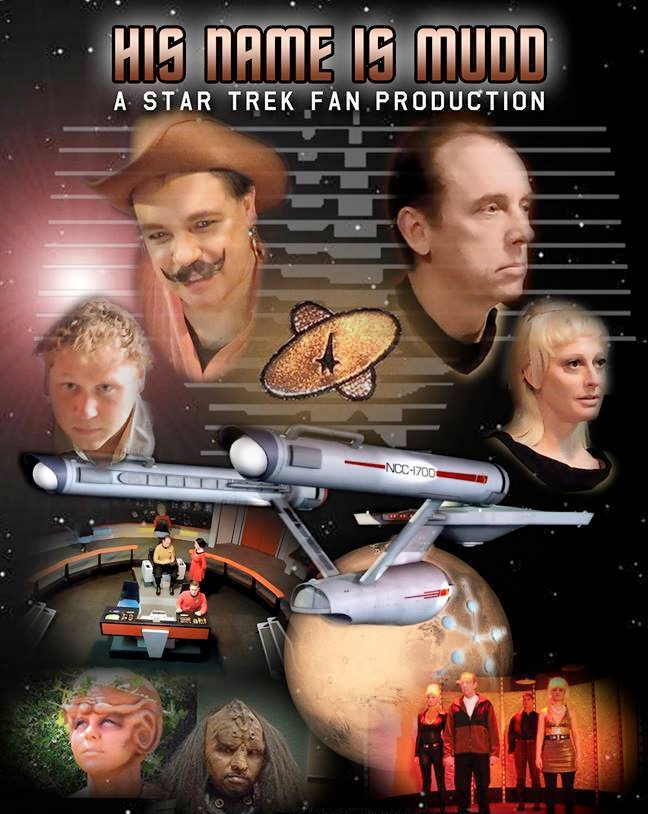 Okay, to finish up, there was the impressive release of "His Name Is Mudd"--written and directed by Glen L. Wolfe--to kick off The Federation Files. If there were ever a game of "Where's Waldo" using the credits of Star Trek fan films, Glen L. Wolfe would surely be Waldo. If you visit Glen's IMDb page, you'll see him having participated in a dozen different fan films and series stretching back to 2013: Star Trek: Renegades, Horizon, Deception, Secret Voyage, Ambush, Equinox, Temporal Anomaly, and multiple episodes of New Voyages and Continues. He's worked on fan films as an actor, producer, cameraman, electrician, and art designer. And now Glen can add writer and director to that list, as well.
"His Name Is Mudd" was filmed at various locations, including at Starfleet Studios in Iowa; down at Starbase Studios in Oklahoma on their bridge, transporter, and sickbays sets; and even up in Ticonderoga, New York at James Cawley's Retro Studios using the briefing room set. If there is such a thing as a "family" of fan filmmakers (and I truly believe there is) this production was indeed a family affair.
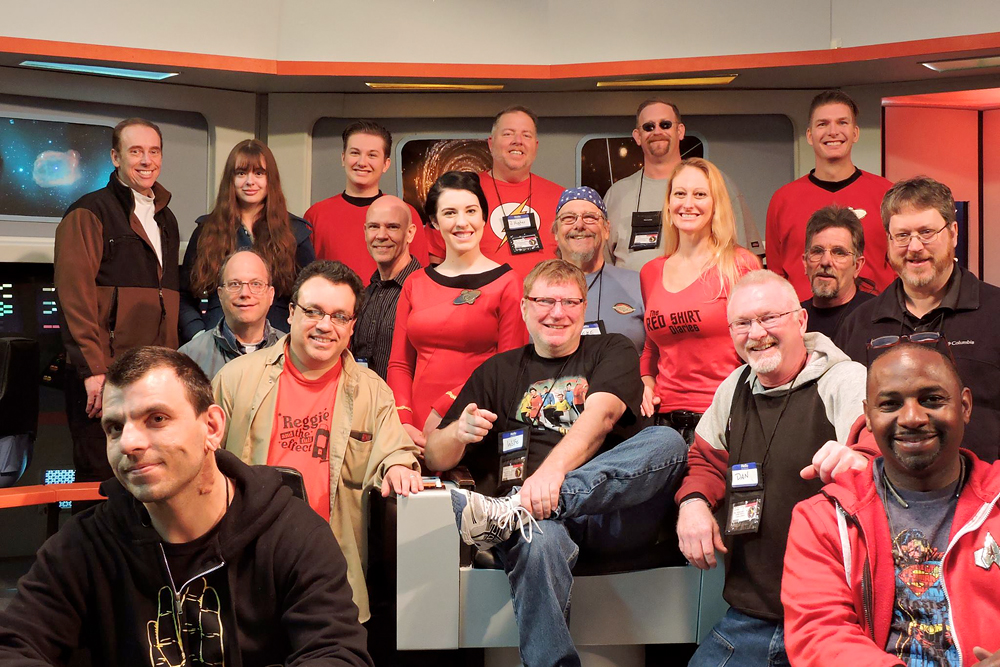 Glen L. Wolfe sits in the captain's chair surrounded by the cast and crew of "His Name Is Mudd," the debut episode of The Federation Files.
But if you like the setting (the USS Constitution) or the characters (including Janice Rand as a junior officer), well, don't get too attached. The Federation Files' Facebook page explains the new series like this:
The Federation Files is an opened look at the Memory Alpha database. The concept is to allow filmmakers a location to make their films available to the fans. Scripts will span the entire Star Trek Universe. Each episode can be free standing, therefore a new cast could be featured every time.
Following the Outer Limits and Twilight Zone format, the fan can view any episode in any order as they do not build on each other.
Again, this first 47-minute long release of The Federation Files was mostly finished when the guidelines were announced, so it was grandfathered in (or so we hope). But one would assume the next episode(s) will comply with the 15-minute, 2-part time limit of guideline #1.
So when all is said and done, I think there's one pretty big take-away from all of this. As much as I and many fans feel strongly that the guidelines went too far and are too restrictive, if I had to choose just one--or even part of one--to revise, it would be the portion of guideline #1 that stipulates no ongoing series: "...no more than 2 segments, episodes or parts, not to exceed 30 minutes total, with no additional seasons, episodes, parts, sequels or remakes." All the rest of them--the 15-minute time limit, the $50,000 crowd-funding cap, the moratorium on perks (everything except the "no paid professionals, which violates California Business and Professions Code, Section 16600)--all of these other guidelines seem almost reasonable in comparison to that one restriction. No ongoing series guts the heart out of so many, many fan efforts. It takes away from us forever the great characters of Aurora. It asks a man and his team who have spent years developing a set of characters and backstory to abandon all they have built and start over from scratch, and then start over from scratch again after that, and again after that...never being given an opportunity to slowly and fully explore and develop a range of characters through a series of stories that touch upon their hopes, fears, strengths, weaknesses, dreams, and aspirations . Right now, everything must be done at warp speed in just 15 minutes (30 for a two-parter): tell a compelling story, establish setting and conflict, provide backstory, drama, and develop the characters before the clock ticks down to zero. And if by some miracle you succeed, kiss those characters and settings good-bye because you can never use them again. Does Guideline #1 really protect the studios? Even capping episode length at 15 minutes, is the rest of that guideline really necessary? Or is it going too far into the realm of unreasonable constraint? I urge the studios, if they consider no other changes, please revise that first guideline. As Ronald Reagan stood in Berlin in 1987 and said, "Mr. Gorbachev, tear down this wall!"...I now say to CBS, "Mr. Van Citters, tear down Guideline #1!" Yeah, I know that sounded hokey, but will you add your voice to mine? If so, the SMALL ACCESS Campaign is preparing to launch Plan B. Please click here to join us.
 Save